

Quick Search:
Why Connect Google Drive to FTP?
Google Drive and FTP (File Transfer Protocol) are both giants in the world of online storage, but they serve different purposes. Google Drive is a modern, collaborative cloud platform, while FTP is the industry standard for managing web servers and transferring large files between computers.
Connecting these two services creates a powerful bridge between your personal files and your professional server environment. Here is why this connection is essential:
- ✔️Eliminate "Double Handling" of Data: Traditionally, if you wanted to move a file from Google Drive to your server, you had to download it to your PC first and then upload it to your FTP. Connecting them allows for direct server-to-server transfer, saving you hours of time and gigabytes of local bandwidth.
- ✔️Off-site Backup & Redundancy: By connecting the two, you can use Google Drive as a secure, secondary backup location for your FTP server data. This protects your website or corporate files against server crashes or accidental deletions.
- ✔️Enhanced Collaboration for Developers: Web developers can keep project assets in a shared Google Drive folder and push them directly to a live FTP production environment. This allows non-technical team members to contribute files that the developer can then deploy instantly.
- ✔️Remote Accessibility: FTP servers can sometimes be difficult to access behind strict firewalls or on mobile devices. By syncing FTP files to Google Drive, you can access, preview, and share your server files from any smartphone or tablet using the Google Drive app.
- ✔️Automated Syncing: Integrating the two allows for automated workflows where files added to a specific Google Drive folder are automatically uploaded to your FTP server, ensuring your website or remote storage is always up to date.
How to Connect Google Drive to FTP? [2 Ways]
To connect Google Drive to FTP and transfer files between them, there are 2 ways you can try. Both of them require the help of third-party tools. So check them out and choose one you prefer.
Way 1. Connect Google Drive to FTP via FileZilla
Using this method, you have to first use Google Drive as FTP server and then connect Google Drive to FPT. How to use Google Drive as FTP? You can make use of a tool called Google Drive Adapter, which allows you to access your Google Drive through FTP. And you can use it in conjunction with any FTP client such as shell FTP, Beyond Compare, FileZilla, etc.
Step 1. Install Java system on your computer and download & install Google Drive Adapter.
Step 2. Launch the program, log in with your Google account.
Step 3. Then click on "Allow" to authorize Google Drive Adapter to access your Google account.
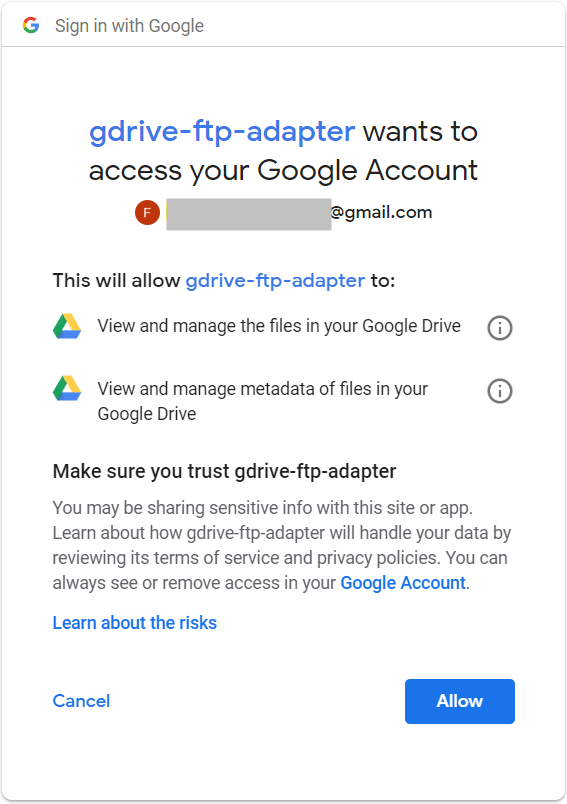
After that, you can use your FTP client to connect Google Drive to it. Here, we will show you how to use the FileZilla client to connect Google Drive to FTP as an example.
Step 1. Open FileZilla, click on "File" and select "Site Manager".
Step 2. Click "New Site" on the left, then choose "Google Drive" in the drop-down list of "Protocol" on the right.
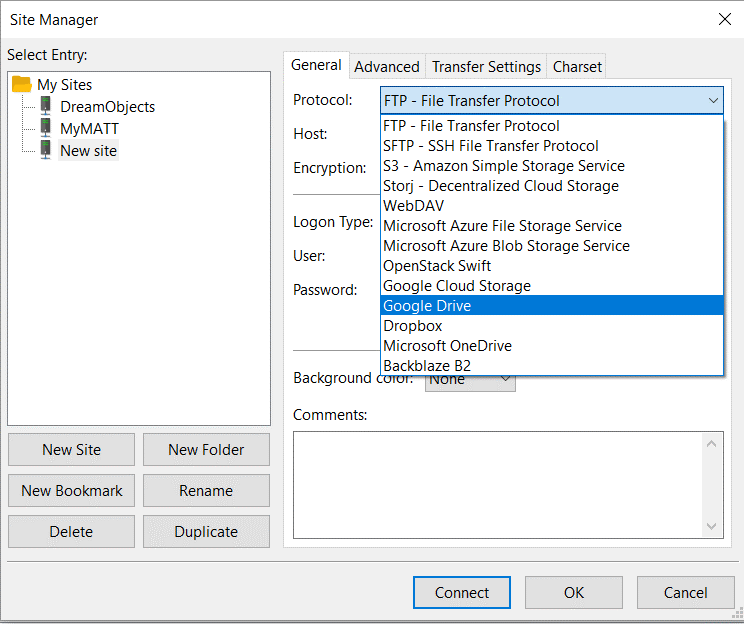
Step 3. Fill in your account and click on "Connect".
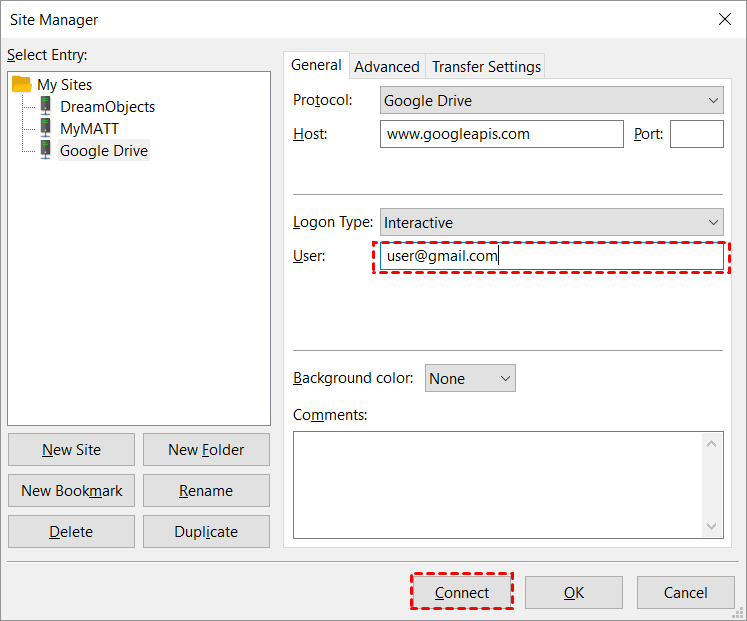
Step 4. Now you can transfer files between Google Drive and FTP in FileZilla.
Way 2. Directly and Easily Connect Google Drive to FTP via MultCloud
If your final purpose of connecting Google Drive to FTP is to transfer files between them, you can use a multiple cloud storage manager named MultCloud, which lets you easily combine these two services together and move from Google Drive to FTP directly. Besides, MultCloud uses the new background transmission technology, so it can still transfer even after power off; thus, scheduled file copy can be realized. Also, for huge data, automatic transfer from Google Drive to FTP can be implemented.

- Perfect Integration: Manage up to 40+ cloud drives centrally.
- Random Migration: Do one-time or incremental migration according to your own needs.
- Real-time Sync: Provide 10 custom sync modes to simplify collaboration.
- Smart Backup: Restore the backed-up data to the previous version at any time.
- Image Saver: Free to save images or videos to local devices or cloud accounts.
- Email Migration: Easily save emails and attachments to all kinds of cloud drives.
- Remote Upload: Directly download URLs, torrent files or magnet links to cloud drives.
Now, we will show you how to connect Google Drive and FTP and transfer files via MultCloud step by step.
Step 1. Create One MultCloud Account
At first, visit the MultCloud official website to register an account. As a web app, MultCloud allows you to transfer, sync and backup files across clouds easily and freely; thus, you don’t need to install it on any clients, and registration is free. After confirming your account in the email, you can log in to MultCloud directly.
Step 2. Add Google Drive and FTP to MultCloud
Add FTP and Google Drive to MultCloud through the "Add Cloud" button. Check Google Drive/FTP, then click the “Next” button.

To add Google Drive, just type a display name as follows. After you click “Add Google Drive” button, the page will automatically jump to the official site for authorization to MultCloud. This is because Google Drive supports OAuth and OAuth is the authorization system of MultCloud. This authorization framework allows third-party applications to establish a connection to cloud drives without a username and password.
To add FTP, you need to enter following information.
Notes:
- Make sure that your FTP account has read/write permissions before file operations; otherwise, MultCloud may be unable to transfer files into your FTP.
- Make sure that there is enough space in your FTP account for your operations, because MultCloud cannot recognize its size temporarily.
Now, you have finished the Google Drive FTP connection, so you can manage it easily. As you can see, MultCloud can manage all cloud storage in one place.
Step 3. Transfer Files from Google Drive to FTP with "Cloud Transfer"
Since you connect Google Drive to FTP on MultCloud, you can do many operations as you like. For example, you can transfer from Google Drive to FTP with "Cloud Transfer". Click on the "Cloud Transfer" button, select Google Drive as the source, select FTP as the destination, click on "Transfer Now," and the whole transfer process will start. You can also schedule it to apply the automatic transfer at a later date. You can enable it by clicking on the "Schedule" button.
If you prefer to use Chrome and the web edition of Google Drive, you can add MultCloud extension.
👍[New Feature] Let's Backup Website to Google Drive Directly
For webmasters and developers, connecting FTP to Google Drive often serves a specific purpose: protecting website data. MultCloud has recently launched a dedicated Website Backup feature designed to automate the backup of your site files and databases to the cloud.
Why use Website Backup?
- ✨Set-and-Forget Automation: Scheduled backups eliminate the risk of human error or forgetting to manually save your data.
- ✨Direct Cloning: If you are moving to a new domain or host, simply use Website Clone to move your files from the old FTP to the new FTP.
- ✨Database Integration: Unlike standard file transfers, this feature specifically handles SQL databases.
- ✨Security: Keeps your website data independent of your hosting provider.
This is the most efficient way to migrate your website to a new host or keep a "fail-safe" copy on Google Drive.
How to use Website Backup to protect your site:
1. Open Website Backup:
In the left-hand sidebar of MultCloud, click on the Website Backup icon.
2. Select Your Website (Source):
Click "Add Website." You can add and choose the FTP/SFTP server that contains your website files.
3. Select Google Drive (Destination):
Select Google Drive as the storage path where you want the backup to be saved.
4. Configure and Run:
-
Schedule: Click the "Schedule" button to set the backup to run daily, weekly, or monthly. This ensures you always have a recent version of your site if it gets hacked or crashes.
-
Backup: Click Backup Now. MultCloud will package your website files and database and store them safely in Google Drive.
Summary
You have two options to connect Google Drive to FTP. While FileZilla is useful for manual, local edits, MultCloud is significantly easier for large-scale migrations and automated tasks.
With the addition of the Website Backup tool, MultCloud is no longer just a file mover—it is a comprehensive management suite for webmasters. Whether you need to sync files via "Cloud Sync," download torrents directly to the cloud, or ensure your entire website is backed up to Google Drive, MultCloud provides a secure, one-stop solution.
Frequently Asked Questions (FAQ)
1. Is it possible to connect Google Drive to FTP for free?
Yes. Both the FileZilla/Adapter method and MultCloud offer free versions that allow you to connect and transfer files between these services without an upfront cost.
2. Can I automate the transfer of files between Google Drive and FTP?
Absolutely. By using the "Schedule" feature within MultCloud, you can set specific times (daily, weekly, or monthly) for files to be automatically copied or synced between the two.
3. Do I need to keep my computer turned on during the transfer?
If you use FileZilla, yes. However, MultCloud processes the transfer on its own servers, so you can start a transfer, shut down your PC, and it will complete the task in the cloud.
4. How secure is my data when connecting FTP to MultCloud?
MultCloud uses 256-bit AES encryption for all transfers and employs OAuth authorization for Google Drive, meaning your passwords are never stored and your data remains private and secure.
5. Can I backup my website's database and files at the same time?
Yes, using the "Website Backup" feature, you can select both your FTP files and your MySQL/MariaDB databases to be saved into a single organized backup on Google Drive.
6. What happens if my internet connection drops during a large transfer?
Because MultCloud operates as a web-based service, a local internet drop won't stop the transfer. Once the task is initiated, MultCloud handles the connection between Google Drive and your FTP server independently.
MultCloud Supports Clouds
-
Google Drive
-
Google Workspace
-
OneDrive
-
OneDrive for Business
-
SharePoint
-
Dropbox
-
Dropbox Business
-
MEGA
-
Google Photos
-
iCloud Photos
-
FTP
-
box
-
box for Business
-
pCloud
-
Baidu
-
Flickr
-
HiDrive
-
Yandex
-
NAS
-
WebDAV
-
MediaFire
-
iCloud Drive
-
WEB.DE
-
Evernote
-
Amazon S3
-
Wasabi
-
ownCloud
-
MySQL
-
Egnyte
-
Putio
-
ADrive
-
SugarSync
-
Backblaze
-
CloudMe
-
MyDrive
-
Cubby

Stay Updated With Our
Latest Tips
Add us as a preferred source on Google to never miss helpful guides.
 Add as preferred source >>