

Is OneDrive the Same as Google Drive?
No, OneDrive and Google Drive are not the same, although they serve similar purposes. Both are cloud storage services that allow users to store, sync, and share files online. However, they come from different companies, integrate with different ecosystems, and offer different features, free storage limits, and platform compatibility.
What is Google Drive?
Google Drive is an online file-sharing cloud storage service launched by Google in 2014. It provides users with a Google account access to cloud space for storing documents, spreadsheets, presentations, images, and videos. Google Drive offers 15 GB of free storage, but this space is shared with Google Photos and Gmail. It is compatible with Windows, Mac, Android, iOS, and other operating systems.
What is OneDrive?
OneDrive, originally known as SkyDrive, is a cloud storage service launched by Microsoft in 2014. It allows users to store, sync, and share various files with others. OneDrive provides 5 GB of free storage for each registered user. As part of Microsoft Office 365, OneDrive works seamlessly on Windows and Mac computers, as well as Android and iOS devices.
Google Drive VS OneDrive: What They Share?
Google Drive and OneDrive are both well-known cloud storage and file-sharing services compatible with various platforms. Below are the key similarities between the two:
- ✔️Cross-platform compatibility: Both services support multiple platforms, including Windows, Mac, iOS, and Android.
- ✔️Storage space: Both offer free and paid storage plans to meet different cloud space requirements.
- ✔️Collaboration: Both allow users to work on the same files with others in real time and grant different levels of access permissions to shared files.
- ✔️Integration with other apps: Both integrate seamlessly with their respective productivity suites—Google Drive works with Google Docs, Sheets, and Slides, while OneDrive integrates with Microsoft Office applications.
- ✔️Sync local data to the cloud: Both enable users to sync or back up data from computers to the cloud, making files accessible across other devices.
Google Drive VS OneDrive: How They Differ from Each Other?
To choose the best cloud storage for your needs, it's essential to understand how these two services differ. Below, we compare Google Drive and OneDrive across seven key aspects—ranging from pricing and free storage to collaboration, security, and file syncing—to help you make an informed decision.
1. Pricing and Storage Limits
To begin, we will compare Google Drive and OneDrive based on pricing and storage limits. Although both provide tiered paid plans, there are notable differences in their pricing structures and storage offerings.
| Storage Plan | Google Drive (Google One) | OneDrive (Microsoft 365) |
| Free | 15 GB | 5 GB |
| 100 GB | $1.99 / month | $1.99 / month (standalone) |
| 200 GB | $2.99 / month | Not available as standalone |
| 1 TB | Not available as standalone | $9.99 / month (Microsoft 365 Personal) |
| 2 TB | $9.99 / month | Not available as standalone |
| 6 TB (1 TB × 6 users) | Not available | $19.99 / month (Microsoft 365 Family) |
| 🏆Google Drive offers cheaper entry-level paid plans, while OneDrive provides better value if you need Office apps and multi-user storage. | ||
Bonus Info: Google Workspace vs OneDrive for Business
For business users, Google Workspace plans start at 6/user/month for 30GB storage,while Microsoft365 Business plans start at 5/user/month for 1 TB per user, with both offering advanced collaboration and admin controls.
| Platform | Version | Price | Storage |
| Google Workspace | Starter | $5.88/user/month | 30 GB per user |
| Standard | $11.76/user/month | 2 TB | |
| Plus | $18.48/user/month | 5 TB | |
| Enterprise | Custom Pricing | Unlimited storage | |
| OneDrive for Business | Plan 1 | $5.00/user/month | 1TB per user |
| Business Basic | $6.00/user/month | 1 TB per user | |
| Business Standard | $12.50/user/month | 1 TB per user |
2. Collaborative Document Editing
When it comes to Google Drive versus OneDrive for collaborative document editing, both offer real-time co-authoring capabilities, but their approaches and user experiences differ significantly.
| Feature | Google Drive | OneDrive |
| Core apps | Google Docs, Sheets, Slides | Microsoft 365 (Word, Excel, PowerPoint) |
| Real-time editing | Yes, with live cursors | Yes, with co-authoring |
| Browser experience | Flawless and native | Functional but less polished |
| Desktop app integration | Not required | Seamless with Microsoft 365 desktop apps |
| Cross-platform consistency | Excellent across all devices | Better on Windows, slightly weaker elsewhere |
| Collaboration polish | Very high (live cursors, comments, suggested edits) | Moderate (co-authoring available but occasional sync delays) |
| 🏆Google Drive is better for pure real-time collaboration, especially for teams that work primarily in browsers. OneDrive is a strong choice if your team already uses Microsoft 365 desktop apps. | ||
3. Document Sharing
OneDrive vs Google Drive: which is the best option for document sharing? File sharing is at the core of any cloud storage service. Both allow users to share documents, folders, and links with others, but they differ in sharing flexibility, permission controls, and external user accessibility. Understanding these differences helps you choose the platform that best fits your sharing needs.
| Feature | Google Drive | OneDrive |
| Sharing methods | Email invites, shareable links | Email invites, shareable links |
| Permission levels | Viewer, Commenter, Editor | Can view, Can edit |
| Link expiration | Available (paid account) | Available (paid account) |
| Password protection | Not available | Available (paid account) |
| External user access | Requires sign-in or Google account (sometimes) | Works without sign-in (if enabled) |
| 🏆For casual sharing, both are comparable. For business or secure external sharing, OneDrive offers more advanced controls. For simplicity and broad accessibility, Google Drive has a slight edge. | ||
4. Email Integration
OneDrive vs Google Drive: which integrates better with email? Email integration is a critical factor when choosing a cloud storage service, as seamless file attachments and link sharing can significantly improve productivity. Both Google Drive and OneDrive offer deep integration with their respective email platforms, but the best choice depends largely on which email service you already use.
| Feature | Google Drive | OneDrive |
| Primary email integration | Gmail | Outlook.com / Microsoft Outlook |
| Insert files as links | ✓ | ✓ |
| Automatic permission management | ✓ | ✓ |
| Save email attachments directly to cloud storage | ✓ | ✓ |
| Integration quality with third-party email | Limited | Limited |
| Ecosystem synergy | Best with Gmail + Google Workspace | Best with Outlook + Microsoft 365 |
| 🏆It depends on your email platform. If you use Gmail, choose Google Drive. If you use Outlook or Microsoft Exchange, OneDrive offers a smoother experience. | ||
5. Security and Privacy
Security and privacy are among the most important factors when choosing between OneDrive and Google Drive for both personal and business use. While no public cloud service can guarantee absolute privacy, both platforms provide strong encryption and authentication systems to significantly reduce risks such as data leaks and account compromise.

Google Drive
Implements multiple layers of protection to secure user data:
- ✅Encryption in transit and at rest using 256-bit AES encryption for all files (including Docs, Sheets, and Slides)
- ✅RSA encryption keys (2048-bit), regularly rotated to enhance protection of private data
- ✅Two-Step Verification (2SV) to reduce unauthorized access risks
- ✅Advanced protection systems, including content detection to help prevent information leakage
Business admin controls, such as:
- ✅Data Loss Prevention (DLP)
- ✅File access logs and audit tools
OneDrive
Emphasizes both personal privacy protection and enterprise-grade compliance features:
- ☑️Personal Security Features
- ☑️AES-256 encryption for data at rest
- ☑️SSL/TLS encryption for data in transit
- ☑️Multi-factor authentication (MFA)
Additional login protections such as:
- ☑️Face recognition
- ☑️Security prompts
- ☑️Strong password policies (up to 13+ character complexity)
- ☑️Personal Vault: A protected encrypted area designed for highly sensitive files
Business Security Features
- ☑️Cross-platform and cloud-environment security integration
- ☑️Identity and device compliance verification for every access request
- ☑️Advanced security, compliance, and identity management across Microsoft 365 ecosystem
- ☑️Supports enterprise compliance standards such as HIPAA and GDPR
While both platforms are highly secure, OneDrive offers slightly stronger protection for sensitive personal data and enterprise compliance needs, whereas Google Drive excels in collaborative cloud security and administrative control.
6. File Storage and Sync
Now, let’s compare how OneDrive and Google Drive store and sync files. Google Drive uses a streaming-based sync approach, designed to minimize local storage usage, while OneDrive combines cloud syncing with strong local system integration:
Google Drive: Cloud-First Streaming Model
- ✅Cloud streaming access: All files are visible in a virtual drive without being downloaded
- ✅On-demand download: Files are only stored locally when opened or explicitly saved offline
- ✅Selective sync (mirror mode): Users can choose specific folders to keep available offline
- ✅Cross-platform support: Works across Windows, macOS, Android, iOS, and even Linux via third-party tools
- ✅Performance: Generally smooth for cloud-only workflows and browser-based usage
OneDrive: Hybrid Sync + Deep OS Integration
- ☑️Files On-Demand: Similar to Google Drive’s streaming model—files appear locally but are stored in the cloud until opened
- ☑️Full local sync option: Users can fully download folders for offline access
- ☑️Native Windows integration: Built directly into File Explorer for seamless file management
- ☑️macOS support: Functional but less tightly integrated compared to Windows
- ☑️Sync behavior: Reliable overall, though performance may slow when handling very large numbers of small files
🏆OneDrive is the better choice for Windows users due to native integration. Google Drive works more consistently across platforms (Windows, Mac, Chrome OS, Linux via third-party tools) and feels snappier for cloud-only file access.
7. Mobile File Backup
When it comes to mobile backup capabilities, Google focuses on full-device data backup, while OneDrive is more centered on media synchronization.
Google Drive: One-Tap Full Backup
With Google Drive, users can enable a simple toggle to back up multiple types of mobile data at once:
- ✅Contacts call history, app&app data, SMS & MMS messages backup
- ✅Calendar events synchronization
- ✅Photos and videos backup
- ✅One-click automatic backup setup
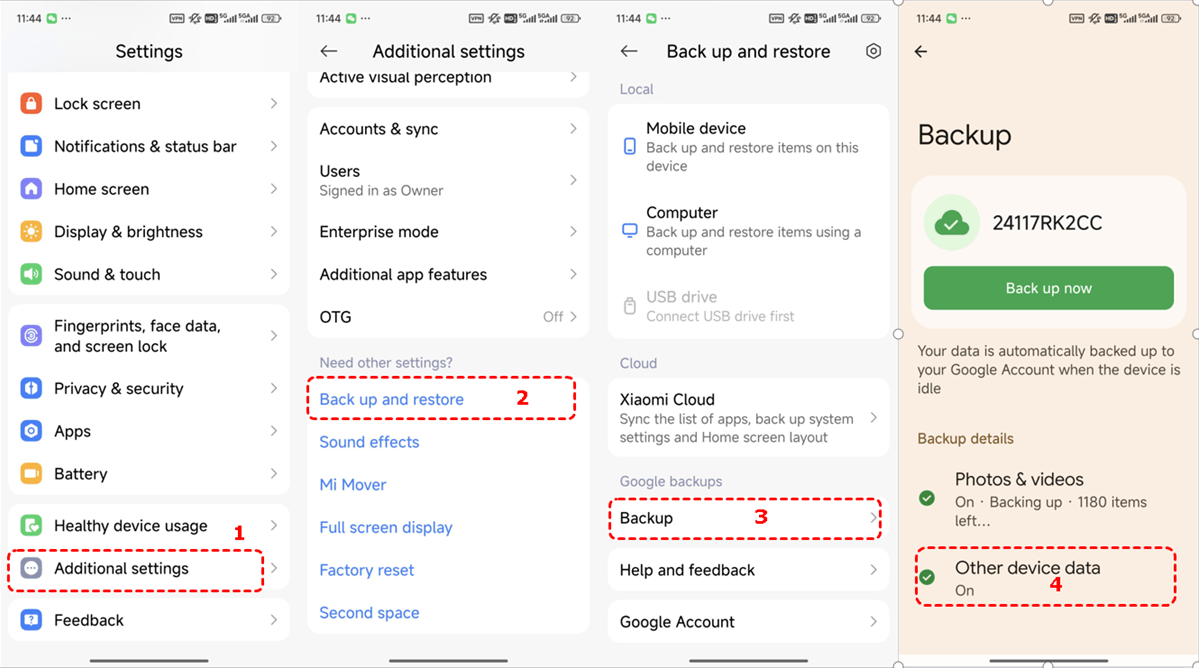
It is not just file storage—it acts as a full mobile data backup solution.This deep integration is especially smooth on Android devices, where Google services are built into the system.
OneDrive: Media-Focused Backup
OneDrive mainly focuses on media file protection and synchronization:
- ☑️Automatic photo and video uploads
- ☑️Camera roll backup support
- ☑️Integration with Windows Photos and Microsoft ecosystem
However, compared to Google Drive, it has some limitations:
- ❌ No contact backup
- ❌ No calendar event backup
- ❌ More focused on file/media sync rather than full-device backup
Summary Recommendation: Google Drive vs OneDrive
| Category | Better Choice | Why |
| Free storage | Google Drive | 15 GB free storage vs 5 GB |
| Entry-level paid plan | Tie | Both offer 100 GB at $1.99/month |
| Office productivity integration | OneDrive | Deep integration with Microsoft 365 apps |
| Real-time collaboration | Google Drive | Superior browser-based co-editing experience |
| Email integration | Depends on ecosystem | Gmail → Google Drive / Outlook → OneDrive |
| Windows experience | OneDrive | Native File Explorer integration |
| Cross-platform consistency | Google Drive | More consistent across OS and web |
| Advanced personal security features | OneDrive | Personal Vault + ransomware recovery |
| Mobile backup (contacts, calendar, media) | Google Drive | Full device backup (contacts + calendar + media) |
| Mobile media backup (photos/videos only) | OneDrive | Simple and strong photo/video sync |
| Cloud-first workflow | Google Drive | Faster, lighter, browser-centric usage |
Bonus Tip: How to Transfer Files between Google Drive and OneDrive
In real-world use, many people don’t actually choose between Google Drive and Microsoft OneDrive—they often use both at the same time. In some cases, you may even want to migrate files from one platform to another to better fit your workflow.So, how to transfer files between OneDrive and Google Drive? Just keep reading, please!
The Traditional Method (Not Recommended)
The most common manual approach is: Download files from Google Drive to your computerand re-upload them to OneDrive (or vice versa).While this works, it has several drawbacks:
❌ Requires a lot of local storage space
❌ Very time-consuming for large file volumes
❌ Easy to make mistakes (missing or duplicated files)
❌ Not suitable for ongoing or frequent transfers
A Faster Alternative: MultCloud
To simplify this process, you can use MultCloud, a web-based cloud file management tool designed for cross-cloud transfersonline without downloading and uploading.It supports about 40 cloud services, including:Google Drive, OneDrive, Dropbox, iCloud Photos, MEGA, iCloud drive, SharePoint, Google Workspace, OneDrive for business, Google Photosand more.
With the help of the Cloud Transfer, Cloud Sync, Cloud Backup, and Team Transfer functions, MultCloud can easily sync, backup, or move files from OneDrive to Google Drive quickly without any hassle.

- ✨Cloud Transfer: Transfer files directly between cloud services without downloading or uploading. Supports one-time or scheduled transfers, making large-scale migration (e.g., Google Drive to OneDrive migration) fast and efficient.
- ✨Cloud Sync: Sync data between clouds seamlessly with 10 flexible modes, including one-way, two-way, and real-time sync for different workflow needs.
- ✨Remote Upload: Upload files directly to cloud storage from URLs, torrents, or magnet links—no need to download locally first.
- ✨Cloud Backup: Back up data from one cloud to another for added protection against data loss and improved data security.
- ✨Team Transfer: Easily migrate all accounts between business clouds. Automatically matches domains/accounts and transfers files in bulk with minimal manual effort.
Transfer from Google Drive to OneDrive via MultCloud
Step 1. Sign up for MultCloud for free. Then click “Add Cloud” to add Google Drive and OneDrive respectively to MultCloud with the secure protection of the OAuth authorization system.

Step 2.Move to the Cloud Transfer tab, add Google Drive to the source, and OneDrive to the destination, or you can choose the sub-directions of the source and destination.
Step 3.Set up your Cloud Transfer task in the “Options”, you can rename, overwrite the file (consistent size or varying size), delete the source file after the transfer is completed, etc.
Step 4.Click “Transfer Now” to start transferring files from Google Drive to OneDrive.
Tip: You can subscribe to MultCloud to set up automatically scheduled cloud file transfer plans (daily, weekly, monthly).
Step 5.When the file transfer starts, you can check the file transfer progress in the Task List tab.
Conclusion
Reviewing the comparison of Google Drive vs OneDrive through this article, if you value price, storage space, and security a lot, it is recommended to choose OneDrive. If you don't require too many of these, you could choose between both clouds according to your specific needs as they both have similar features. If you want to use Google Drive and OneDrive together while managing these clouds easily and quickly, it would be better if you could use MultCloud to achieve the best cloud file management.
FAQs
Google Drive vs OneDrive free: which gives more storage?
Google Drive:15 GB free, shared across Google Drive, Gmail, and Google Photos.
OneDrive: 5GB free, separate from other Microsoft services.
Google Drive clearly wins for free storage—three times more than OneDrive. However, Google's free tier is shared across multiple services, so heavy Gmail or Photos users may consume space quickly.
Do I Need OneDrive If I Use Google Drive?
Not necessarily. Google Drive is usually enough for personal cloud storage. But OneDrive becomes useful if you:
- Use Microsoft 365 (Word, Excel, Windows integration)
- Work heavily on Windows PCs
- Need tight integration with Office files
If you want to manage both clouds together, tools like MultCloud let you transfer or migrate files directly between Google Drive and OneDrive without downloading/uploading manually.
Is Google Drive As Safe As OneDrive?
Both are considered secure cloud storage platforms.Google Drive and OneDrive both offer:1) Encryption in transit and at rest; 2) Two-factor authentication;3) Advanced security monitoring.
OneDrive is often preferred in enterprise environments using Microsoft security policies while Google Drive benefits from Google’s large-scale threat detection systems. Overall, both are safe if you enable strong account security (especially 2FA).
OneDrive vs Google Drive for Photos, Which is Better?
Google Drive (or more specifically Google Photos) is generally better for photos because: better AI search (faces, objects, locations); smarter automatic organization; easier sharing and album creation. OneDrive is better if:
- You already use Windows and Microsoft ecosystem
- You want photos mixed with office files in one place
- You prefer automatic camera upload from PC/phone backup
For pure photo management: Google is stronger. If you want to move photos from OneDrive to Google Photos, MultCloud can help.
What Should You Not Store in Google Drive?
Avoid storing highly sensitive or risky data in Google Drive unless properly secured:
- Passwords or private keys (unless encrypted vaults)
- Highly confidential business secrets without encryption
- Sensitive identity documents without 2FA protection
- Legal/financial files if your account security is weak
If you must store sensitive files, encrypt them before uploading.
Can I Connect Google Drive to OneDrive?
Yes, you can connect Google Drive to OneDrive, but not natively. Google Drive and OneDrive don’t offer direct built-in syncing together. However, you can connect them using a cloud management tool like MultCloud. With it, you can set up cloud-to-cloud sync to sync files between Google Drive and OneDrive. This is the easiest way to move data without downloading anything locally.
MultCloud Supports Clouds
-
Google Drive
-
Google Workspace
-
OneDrive
-
OneDrive for Business
-
SharePoint
-
Dropbox
-
Dropbox Business
-
MEGA
-
Google Photos
-
iCloud Photos
-
FTP
-
box
-
box for Business
-
pCloud
-
Baidu
-
Flickr
-
HiDrive
-
Yandex
-
NAS
-
WebDAV
-
MediaFire
-
iCloud Drive
-
WEB.DE
-
Evernote
-
Amazon S3
-
Wasabi
-
ownCloud
-
MySQL
-
Egnyte
-
Putio
-
ADrive
-
SugarSync
-
Backblaze
-
CloudMe
-
MyDrive
-
Cubby

Stay Updated With Our
Latest Tips
Add us as a preferred source on Google to never miss helpful guides.
 Add as preferred source >>