

User Case
Can Google Drive be utilized as an FTP Server? I possess the host, username, and password details, and through FileZilla, I can access Google Drive folders, upload and download data, and automate backups with various software. The specific protocol, whether FTP or SFTP, is not crucial.
If you want to make SFTP access to Google Drive, you can integrate SFTP to Google Drive and sync files between them. After syncing, Google Drive files can be accessed via SFTP easily. Read the following sections and learn how to achieve it if you prefer this way.
Difference between FTP and SFTP

Although we mainly discuss how to make SFTP to Google Drive integration, we would first briefly tell the differences between SFTP and FTP since some users may be confused about them.
FTP (File Transfer Protocol) and SFTP (Secure File Transfer Protocol) are both used for transferring files, but they differ significantly in terms of security.
FTP is a standard network protocol that transfers files between a client and a server, but it lacks encryption, making data vulnerable to interception. Passwords and files are transmitted in plaintext, posing a security risk. Additionally, FTP does not provide built-in mechanisms for secure authentication.
On the other hand, SFTP provides a secure channel for file transfer. SFTP encrypts data during transmission, offering a higher level of security compared to FTP. It uses a combination of public-key cryptography and user credentials for authentication, ensuring confidential information remains protected. SFTP is widely favored for secure file transfers, especially when dealing with sensitive data, as it addresses the vulnerabilities associated with plain FTP.
Why Sync SFTP to Google Drive?
Syncing files from SFTP servers to Google Drive has become a common requirement for businesses and developers who need a more flexible and accessible way to manage server data. However, Google Drive does not natively support SFTP connections, which means you cannot directly connect an SFTP server to Google Drive for file transfer or synchronization.
As a result, users often look for ways to bridge the gap between the two platforms. Common scenarios include:
- ★Tips:
- Backing up website or application files from an SFTP server to Google Drive,
- Creating an off-site backup of important server data for disaster recovery,
- Accessing server files from anywhere without using FTP software,
- Sharing server-generated reports, logs, or media files through Google Drive,
- Migrating data from legacy SFTP storage to a cloud-based workflow.
Since direct integration is not available, many users rely on cloud manage services to automate file transfer, backup, and synchronization between SFTP/FTP and Google Drive.
How to Easily Integrate SFTP to Google Drive
As mentioned before, we recommend integrating SFTP to Google Drive by syncing files between them. To create a sync task, you can use the free cloud management service MultCloud. It can help you centralize your multiple cloud storage services like Google Drive, Google Workspace, FTP, SFTP, Dropbox, and so on. After adding these clouds to MultCloud, you can directly upload, download, share, and delete files and folders on just one web.
Make SFTP and Google Drive Integration by Cloud Sync
To sync SFTP to Google Drive, MultCloud offers its professional solution – Cloud Sync. It specializes in cloud-to-cloud sync and gives 10 sync modes, such as Real Time Sync, Two-way Sync, Incremental Sync, and Cumulative Sync.
- Real Time Sync: Any modification of a cloud will be updated to another cloud in real time.
- Two-way Sync: The sync task will proceed both ways between SFTP and Google Drive at the same time.
- Incremental Sync: Only the modified or added file will be synced next time.
- Cumulative Sync: Even if you delete some files in the source cloud, these files will not be deleted in the target cloud in the later sync process.
Now, let’s explore how to integrate SFTP with Google Drive on MultCloud.
Step 1: Create a free MultCloud account when you enter its web.
Step 2: Click “Add Cloud” and choose the SFTP icon. Then, tap the downward arrow and choose “SFTP”. Also, fill in the server, username, and password boxes, and click “Add SFTP Account” to add SFTP to MultCloud.
Step 3: Add Google Drive to MultCloud with the same operations in Step 2.
Step 4: Select “Cloud Sync” in the left navigation bar and choose SFTP as the source cloud and Google Drive as the target cloud.
- If you just want to sync SFTP files to Google Drive, you have to distinguish the source cloud and the target cloud. If you choose Two-way Sync, the selection does not matter since the task runs both ways.
Step 5: Open “Options” and choose which sync mode you want to apply to your task if need them. Finally, press “Sync Now” to start syncing.
Notes:
- If you want to auto-select files that you want to transfer or ignore, you can use “Filter” in “Options”.
-
The "Schedule" function enables your synchronization tasks to execute daily, weekly or monthly on schedule once you finish setup.
- MultCloud offers 5 GB of free traffic every month. If you sync more than 5 GB of files at once, the task may pause in half. In this regard, you can upgrade your plan to get up to lifetime limited traffic and enjoy faster sync speed.
Manage SFTP and Google Drive on MultCloud
After syncing SFTP to Google Drive or Google Drive to SFTP by Cloud Sync, you can connect to Google Drive via SFTP by operations like uploading files to Google Drive via FTP or downloading SFTP files on Google Drive. Instead of going to different cloud sites or apps, you can also upload, download, or share files on MultCloud.
- If you want to download a file, you can select the file in Google Drive/SFTP and click “Download” in the upper bar.
- If you want to upload files to Google Drive/SFTP, enter the corresponding cloud and click “Upload File” in the upper-left corner.
- If you want to share a file, choose the file and click “Share”. Then you can choose how to share this file.
Extra Tips: How to Backup SFTP and Database Files to Google Drive via MultCloud
Syncing SFTP files to Google Drive is a great way to protect website assets such as images, themes, plugins, scripts, and configuration files. However, for most websites, files are only part of the picture. A complete website typically consists of two essential components: website files stored on an SFTP server and database data that stores posts, user accounts, comments, product information, settings, and other dynamic content.
If you back up only your SFTP files, your website may still be impossible to fully restore after a server crash, hacking incident, or accidental deletion because critical data remains in the database. Beyond Cloud Sync, MultCloud also comes with a Website Backup feature. You can back up your entire site including SFTP contents and database files to cloud storage such as Google Drive for comprehensive protection of your website.
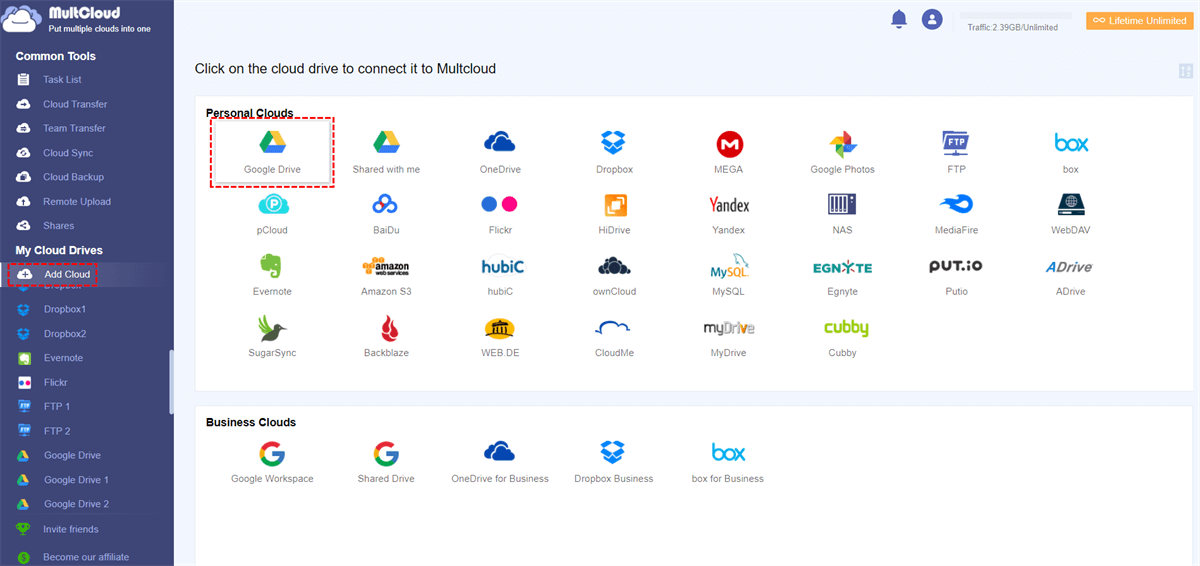
Step 1. Log in with your account on MultCloud and click "Add Cloud" > Google Drive to grant access to MultCloud.
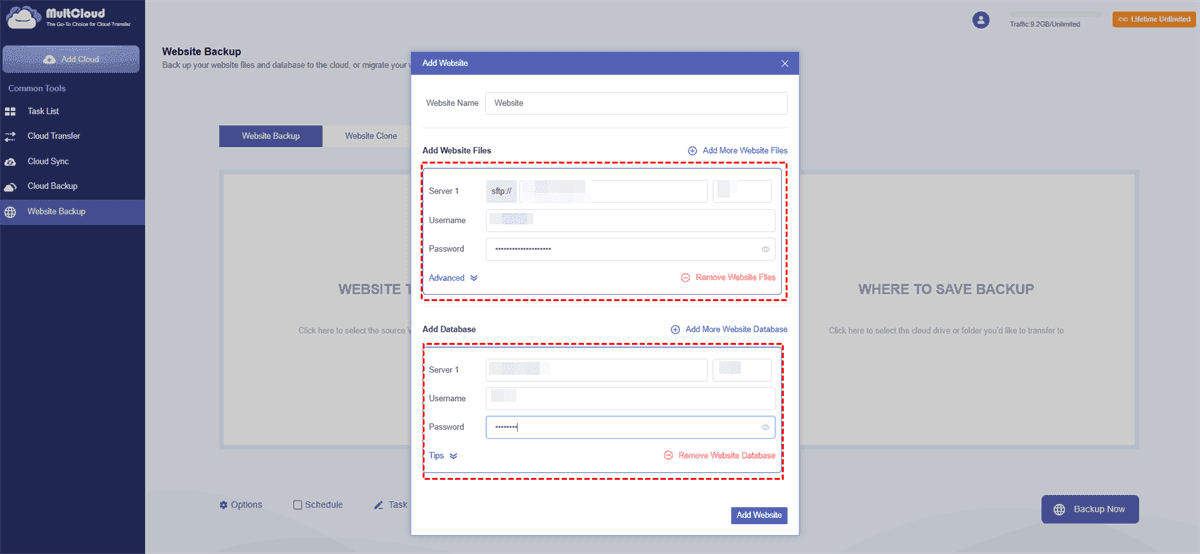
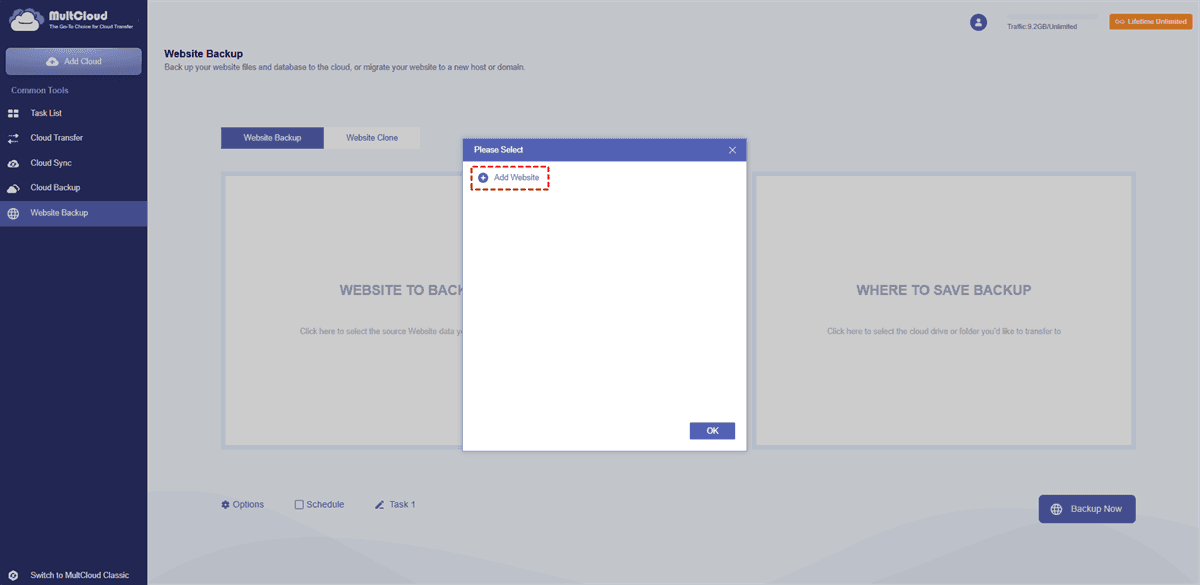
Step 2. Go to the Website Backup tab in the left sidebar and click "WESBITE TO BACKUP" > "Add Website". Enter your SFTP and database server, username, password to add your website.
Step 3. Select the files of your website as the source and Google Drive as the destination drive, then click "Backup Now" to backup your SFTP and database to Google Drive.
Similarly, you can also set email notifications and schedule backup using the "Options" and "Schedule" feature.
Conclusion
If you plan to integrate SFTP to Google Drive, you may try to sync them by MultCloud Cloud Sync. You must have an enjoyable experience when creating and running a sync task on MultCloud. If your goal is disaster recovery or long-term website protection, backing up both SFTP files and databases with MultCloud Website Backup function is highly recommended.
You can restore your site easily from previous backup versions. Additionally, you can try other functions like Cloud Backup to auto-backup SFTP/FTP files to Google Drive.

- Cloud Transfer: Automatically Transfer files between clouds without downloading.
- Cloud Backup: Backup files to another cloud and restore with different versions.
- Team Transfer: Transfer files between business clouds with sub-accounts matching.
- Email Migration: Migrate emails and attachments to the cloud as PDF files at once.
- Image Saver: Save images from Instagram, website, and Google Search to the local or cloud.
FAQs
Q1: Can I FTP files to Google Drive?
Q2: Why do people still use SFTP?
Q3: How do I transfer files from FTP to Google Drive for free?
Q4: How to automatically sync SFTP to Google Drive securely?
Q5: How to schedule SFTP file transfers to Google Drive?
Q6: How to sync client SFTP uploads into Google Drive?
MultCloud Supports Clouds
-
Google Drive
-
Google Workspace
-
OneDrive
-
OneDrive for Business
-
SharePoint
-
Dropbox
-
Dropbox Business
-
MEGA
-
Google Photos
-
iCloud Photos
-
FTP
-
box
-
box for Business
-
pCloud
-
Baidu
-
Flickr
-
HiDrive
-
Yandex
-
NAS
-
WebDAV
-
MediaFire
-
iCloud Drive
-
WEB.DE
-
Evernote
-
Amazon S3
-
Wasabi
-
ownCloud
-
MySQL
-
Egnyte
-
Putio
-
ADrive
-
SugarSync
-
Backblaze
-
CloudMe
-
MyDrive
-
Cubby

Stay Updated With Our
Latest Tips
Add us as a preferred source on Google to never miss helpful guides.
 Add as preferred source >>